
Have a question about your hair?
Ask anything about caring for your braids, twists, locs, curls or scalp, and get an answer in seconds.
General hair care guidance. For your own install, pricing or booking, Benny is here for you. For medical concerns, see a dermatologist.
Healthy styles start before the first braid
Braids protect hair, but they also lock in whatever condition your hair and scalp are in on install day. Preparing well is the single biggest thing you can do for a style that lasts.
Preparing your natural hair
- Cleanse thoroughly 1–2 days before. Use a clarifying or gentle shampoo to remove old product, oil and buildup. Buildup trapped under braids is one of the biggest causes of itching and flaking later.
- Deep condition. Your hair will go weeks without a full treatment, so give it moisture and strength now. Rinse well so nothing is left behind.
- Detangle gently and completely. Work in sections, from ends up to roots, with fingers or a wide-tooth comb. Tangles left in now become knots and breakage later.
- Trim split or damaged ends if you need to. Braiding over weak ends only hides the damage.
- Moisturize lightly, then seal. A light leave-in and a small amount of oil on the lengths is enough. Arrive with clean, lightly moisturized hair, not greasy hair.
- Stretch with care. If your hair needs stretching, use low or cool heat, or heat-free methods like banding or braiding it out overnight. High heat before a long protective style weakens hair you're trying to protect.
Preparing your body
Your scalp and hair are fed from the inside. In the days before your appointment:
- Drink plenty of water. A hydrated body shows up as a less dry, less itchy scalp.
- Sleep well the night before. Installs take hours, and a rested body handles sitting and tension better.
- Eat a proper meal before you come, and bring water and a snack for a long session.
- Tell your braider about any scalp sensitivity, tenderness, thinning areas or recent hair loss so the install can be adjusted around them.
Treating your BGH hair before install
- Keep it sealed in its pack until install day, away from dust, heat and direct sun.
- Don't comb or brush it out ahead of time, especially French Curls. Opening the curls early creates frizz before you've even started.
- Sensitive to synthetic hair? Some people rinse extensions in a diluted apple cider vinegar soak and let them dry fully before install. Ask Benny before you do this, especially with curly textures.
The first days matter most
Your scalp is adjusting to the new style. How you treat it in the first week sets up the rest of the wear.
The first 72 hours
- Let it settle. Wear your style down or loosely gathered. Avoid high ponytails, top knots and tight buns for at least the first week.
- Don't pile on products. Your scalp was just cleansed. Give it a few days before you add anything.
- Start the bonnet habit from night one.
Know what's normal and what isn't
Slight snugness for a day or two can be normal. Pain is not. Small bumps at the root, throbbing, headaches or redness, especially around the edges, are signs of too much tension. Don't wait it out. Contact Benny so it can be loosened or redone, because ongoing tension can lead to lasting hair loss at the hairline.
Throughout your wear
- Mist lightly when hair feels dry, rather than soaking it.
- Keep hands off. Constant touching, twisting and pulling causes frizz and loosens the roots.
- Wear your style for the time recommended, not longer. Overdue styles lead to matting, buildup and breakage at takedown.
When it's time for takedown
- Give yourself time. Rushing takedown is where a lot of breakage happens.
- Expect shed hair. Hair you would normally shed daily collects in the braid, so seeing it at takedown is normal.
- Detangle gently in sections from ends to roots, then cleanse and deep condition.
- Let your hair and edges rest for a little while before your next install.
Why your scalp itches and how to stop it
Itching is your scalp telling you something. Scratching only covers the signal and roughs up your style. The real answers are inside and outside your body.
Common causes
- Dryness: not enough water inside or moisture outside.
- Buildup: product, oil, sweat and dead skin trapped at the roots.
- Over-oiling: too much oil clogs pores and attracts dirt.
- Leftover shampoo or conditioner that wasn't rinsed out.
- Tension from braids that are too tight.
- Sensitivity to synthetic fiber or to a product.
- Stress and lack of sleep, which show up on your skin, including your scalp.
Care from the inside
- Stay hydrated. Water throughout the day keeps skin, including your scalp, less dry and tight.
- Sleep well and consistently. Your body repairs skin and hair while you rest. Poor sleep often shows up as a dull, irritated scalp.
- Eat for your hair. Protein (eggs, beans, fish, chicken), iron-rich foods (leafy greens, lentils), healthy fats (avocado, nuts, salmon) and plenty of fruits and vegetables give hair what it needs to grow strong.
- Manage stress. High stress is linked to scalp flare-ups and shedding. Rest, movement and time for yourself are hair care too.
- Limit what dehydrates you, like too much alcohol and caffeine without enough water.
Oiling is really about massage
Most of the benefit doesn't come from the oil. It comes from the massage. Gentle scalp massage boosts blood flow, loosens dead skin, relieves tension and simply feels good. Oil is just there to help your fingers glide.
How to do it right
- Use a light oil and very little of it. A few drops on your fingertips is enough. Lightweight oils like jojoba or grapeseed sit better under braids than heavy greases.
- Apply to the scalp between the parts, not all over the braids.
- Massage with the pads of your fingers, never your nails, in small slow circles for 3–5 minutes. Move from your hairline to the crown and down to the nape.
- Keep the pressure gentle around the edges and at the roots of each braid, so you don't add tension.
- Do it a few times a week, not every day. Even a massage with no oil at all is good for your scalp.
When the itch hits
- Don't scratch with nails, combs or pins. Press, tap or gently pat the spot instead.
- Try a light mist, or a cotton pad with a little witch hazel dabbed between the parts to refresh the scalp.
- If you have buildup, cleanse your scalp. See Washing & Drying below.
- See a professional if itching comes with strong redness, swelling, bumps with pus, open sores, patches of hair loss or flaking that doesn't improve. A dermatologist can tell you what's really going on.
Yes, you can wash your braids
A clean scalp is a healthy scalp. Washing every 2–3 weeks, or sooner if you work out or sweat a lot, keeps buildup and itching away. The drying matters as much as the washing.
How to wash
- Choose a shampoo that suits your hair and scalp. A gentle, moisturizing (sulfate-free) shampoo for regular washes. A clarifying shampoo if you have heavy buildup. A soothing formula if your scalp is sensitive or dry.
- Dilute it with water in an applicator bottle, so it reaches your scalp and rinses out easily.
- Apply directly to the scalp between the parts and massage with your finger pads. Don't scrub the braids or rub them together.
- Squeeze, don't rub, the lather down the length of the braids.
- Rinse thoroughly, longer than you think you need. Leftover shampoo is a major cause of itching.
- Condition. Apply a lightweight conditioner, focusing on your own hair and the ends rather than piling it on the roots. Rinse completely.
How to dry. This is where damage happens.
Braids hold a lot of water. If they stay damp inside, they can develop a sour, mildew-like smell and leave your scalp irritated. If you use too much heat to speed it up, you damage both your natural hair and the braiding fiber.
- Squeeze out excess water gently with your hands, braid by braid or in sections.
- Blot with a microfiber towel or a soft cotton T-shirt. Wrap and press. Never rub, which causes frizz.
- Air dry as much as possible. Wash early in the day so you're not going to bed with wet braids.
- If you use a dryer, keep it on cool or low, keep it moving, and hold it at a distance. A hooded dryer on low or a diffuser works well.
- Make sure the roots and scalp are fully dry before putting on your bonnet or tying your hair up.
Every BGH texture has its own needs
The basics above apply to every style. Here's how to care for the specific BGH hair in your install.
BGH Pro
For box braids, knotless braids and other sleek braided styles. These looks are all about neat, smooth lines.
Keeping it neat
- Don't comb or brush the braids. Smooth them with your palms instead.
- Tame frizz with a mousse set: apply a little mousse along the braids, smooth down, then tie them down with a satin scarf for 15–20 minutes and let it set.
- Flyaways that pop out over time can be carefully snipped close to the braid. Never pull them.
- Your ends were sealed at install. Avoid tugging or unravelling them.
Avoid
- Heavy oils and greases on the braids. They make the fiber dull and sticky and attract lint.
- Constant twisting and playing with the roots, which loosens your braids and brings frizz.
BGH Luxe Passion Twists
For passion twists, butterfly locs and similar styles. These have a soft, slightly fluffy texture, and a little fuzz is part of the look. The goal is to keep it intentional, not matted.
Keeping it fresh
- Never brush or comb. If ends start to tangle, separate them gently with your fingers.
- Refresh with a light mist of water and a little mousse, then smooth with your palms.
- For butterfly locs, avoid rubbing the locs together. That's what causes clumping and matting.
Avoid
- Heavy products. This soft fiber picks up buildup and lint easily.
- Sleeping without your bonnet. Friction makes this texture tangle fastest.
BGH Afro
Afro kinky texture, in 1B Natural Black, made to blend with natural coils. Kinky texture loves shape and moisture but hates being over-handled.
Keeping it soft and full
- Shape with your fingers or a wide-tooth pick, working gently from the ends. Never rake through from the root.
- Refresh with a light mist of water and a little leave-in, then fluff with your hands.
- Keep it covered at night so it holds its shape and doesn't flatten or tangle.
Avoid
- Over-manipulating it. Constant picking and touching leads to matting and knots.
- Heavy oils. They clump the texture and weigh it down.
BGH Premium French Curls
French Curls are all about soft, bouncy definition. Treat the curls gently and they'll stay beautiful for your whole wear.
Detangling
- Use your fingers only. Never a brush or a fine-tooth comb. Brushing breaks the curl pattern into frizz.
- Apply a curl mousse first, then gently separate any tangled curls with your fingers, working from the ends up.
- Separate in small sections. Take your time.
Refreshing
- Lightly mist, scrunch in a small amount of mousse, and let it set. Mousse restores definition without weighing curls down.
- Avoid heavy oils and greases on the curls. They make synthetic curls look limp, sticky and dull.
- If a few ends get frizzy over time, they can be carefully trimmed.
At night
- Gather your curls loosely on top of your head ("pineapple") and cover with your BGH Satin Bonnet so they don't get crushed or tangled while you sleep.
The BGH Satin Bonnet
Every BGH pack includes our Satin Bonnet. It's not an extra. It's part of the system, because how you sleep decides how your style looks in week three.
What happens while you sleep
You move through the night, and your hair rubs against your pillow for hours. Cotton pillowcases absorb moisture from your hair and scalp and create friction that roughens braids, causes frizz and pulls at your edges.
What satin does instead
- Reduces friction: braids stay smooth and neat for longer.
- Protects your edges: less rubbing and pulling at your most delicate hair.
- Holds moisture in: your hair and scalp stay less dry and less itchy.
- Keeps curls defined instead of crushed and tangled.
- Keeps lint and dust out of your braids, and oil off your pillow.
- Extends the life of your style, so you get more weeks from every install.
Using it well
- Wear it every night, from night one of your install.
- Gather your braids loosely inside. Don't twist them tightly to fit.
- Only put it on when your hair is completely dry.
Keep your bonnet clean
Your bonnet sits on your scalp every night, collecting sweat, oil, product and dead skin. A dirty bonnet puts all of that right back onto your hair and scalp, which can bring itching, odor and breakouts along the hairline. A clean bonnet protects your style. A neglected one works against it.
- Wash it about once a week, or more often if you sweat a lot, work out, or use oils and products.
- Hand wash in cool or lukewarm water with a gentle detergent or a little mild shampoo. Hot water can damage satin's smooth finish.
- Swish and press gently. Don't scrub, twist or wring it hard. That roughens the satin and stretches the band.
- Rinse well until no soap is left.
- Air dry flat or hang it in the shade. Skip the high-heat dryer and direct sun.
- Avoid bleach and fabric softener, which wear out the fabric and leave residue.
Style your braids without stressing them
Your braids can still be styled. The rule is simple: if it pulls, it's too tight. These looks keep weight and tension off your roots and edges.
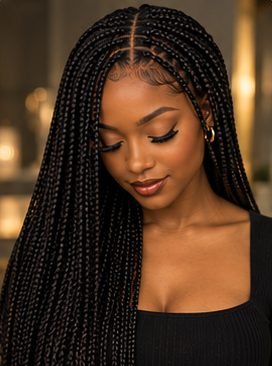
Worn Down
The lowest-tension style there is. Let them hang freely.
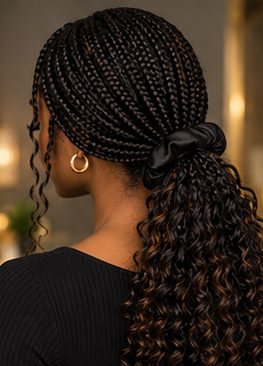
Low Loose Ponytail
Gathered at the nape with a soft scrunchie, never tight.
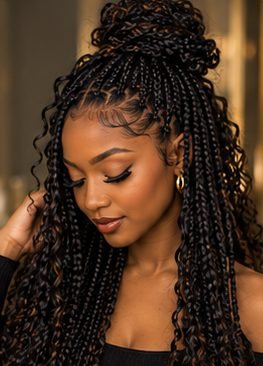
Half Up, Half Down
Top section loosely gathered, the rest worn down.
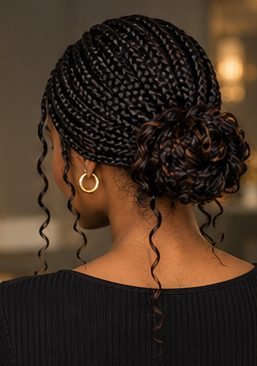
Low Loose Bun
Wrapped softly at the nape. Skip the high top knot.
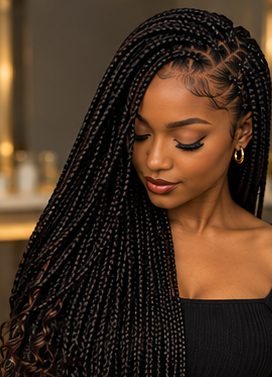
Side-Swept
Braids draped over one shoulder, loosely, without pulling the opposite side.
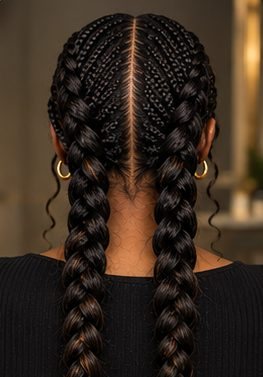
Two Loose Plaits
Braids gathered into two relaxed sections at the back.
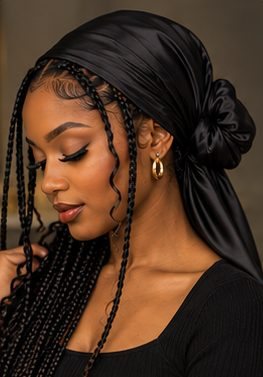
Scarf Wrap
A silk or satin scarf wrapped loosely. Chic and protective.
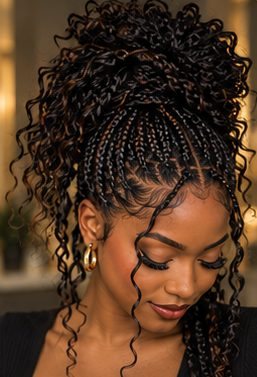
Loose Pineapple
Gathered loosely on top for sleeping, under your bonnet.
Style inspiration images.
Styles to avoid, especially in the first week
- Tight high ponytails and top knots
- Pulling all your braids tightly to one side
- Slicking or pulling your edges tight with gel and brushes every day
- Heavy accessories, or wrapping braids tightly around themselves
- Keeping the same updo for days at a time. Switch it up and give your roots a rest.
Take it down as gently as it went in
Your takedown matters as much as your install. Rushing it is where most breakage happens, so set aside a relaxed afternoon.
When to take it down
Most styles are best worn 4–8 weeks (box braids up to 10). Your style on the Services page shows how long it lasts. Keeping a style in longer leads to matting and buildup at the root, which makes takedown harder on your hair. Mark your takedown date when you get your install, and book your next look a week ahead so your hair isn't left unprotected.
The golden rule: never comb dry hair
The hair you'd normally shed every day stays trapped inside your braids for weeks. Pulling a comb through it dry can knot and snap your own hair. Moisture gives it slip.
Your takedown spray
- 1 part pure aloe vera juice
- 2 parts water
- Mix in a clean spray bottle. A little leave-in conditioner works too.
Step by step
- 1. Snip safely. Cut the extension hair 3–4 inches below where your natural hair ends. When in doubt, cut lower.
- 2. Unravel and spray. Unbraid down to the root, then mist the buildup at the base of each braid and give it a few seconds to soften.
- 3. Fingers first. Gently separate the shed hair with your finger pads before any comb touches it.
- 4. Comb from the ends up. Mist again, then use a wide-tooth comb, starting at the ends and working slowly toward the root.
- 5. Reset. Wash, deep condition, and let your hair and edges rest before your next install.
Seeing a lot of shed hair is normal
It's weeks of daily shedding coming out at once. If you see bald patches, breakage at the edges, or a sore or flaky scalp, check with a dermatologist before your next style.
Ready for your next look? Book →
Rather leave it to us? Takedown is $40 when you rebook your next install.
Find the cause, fix it for good
Most braid problems have a reason behind them. Treat only the problem and it keeps coming back. Fix the reason, and it stops.
Frizz within two weeks
Common causes
- Sleeping on cotton, which rubs and dries your braids all night
- Sweat or water left drying slowly at the roots
- Braids installed too loose, or hair that was not fully stretched
- Fiber that tangles easily
- Constant rubbing from collars, scarves and hoods
The BGH fix
Sleep in your BGH Satin Bonnet every night, dry your roots fully on a cool setting after workouts or washing, and start with an evenly tensioned install using hair that separates clean.
Thinning or breakage at the edges
Common causes
- Braids installed too tight at the hairline
- Extensions that are too heavy for your hair
- Wearing a style longer than it should be worn
- The same tight ponytail or updo, day after day
- A rushed or dry takedown
- Gel and brushing to slick the edges every day
The BGH fix
Parts sized to your hair with gentle tension at the edges, lighter hair where you need it, takedown on time at 4–8 weeks, low-tension styling, and a careful takedown.
If you notice bald patches, scalp pain or sudden heavy shedding, please see a dermatologist. Some causes are medical, and a doctor can tell you for sure.
Braids loosening or slipping at the roots
Common causes
- New growth, which is normal after a few weeks
- Sections too small for the thickness of your hair
- Heavy oils and products making the hair slippery
- Washing more often than your style needs
The BGH fix
Sections matched to your hair, a few drops of light oil instead of heavy products, gentle washing only when needed, and booking your next look before the style is overdue.
Flakes and buildup
Common causes
- Gel and heavy styling products
- Shampoo or conditioner not fully rinsed out
- Oil applied heavily and often
- A dry scalp
The BGH fix
BGH installs are gel-free by default. Use light oils sparingly and rinse thoroughly. For itching and dryness, see Scalp Health.
Bumps or soreness after your install
Common causes
- Too much tension during the install
- Extensions that are too heavy
- Tight updos in the first few days
The BGH fix
Gentle tension from one braider who checks in with you, and loose styles for the first week. Tell Benny right away if anything feels tight, during your session or after.
If bumps last more than a few days or feel painful, loosen your style and check with a dermatologist.
The habits we take for granted
Small everyday habits add up, for better or worse.
Do
- Prep your hair clean, moisturized and detangled before install
- Drink water and get enough sleep
- Massage your scalp with your finger pads
- Use a few drops of light oil, a few times a week
- Wash with a shampoo that suits your hair and scalp, then condition
- Rinse thoroughly and dry completely
- Use cool or low heat only
- Wear your BGH Satin Bonnet every night
- Detangle with your fingers, using mousse to refresh
- Wash your bonnet weekly
- Speak up if your braids hurt
Don't
- Braid over dirty, tangled or product-heavy hair
- Scratch with nails, combs or pins
- Pour oil or grease on your scalp every day
- Leave shampoo or conditioner in your braids
- Go to sleep or cover your hair while braids are wet
- Blast your braids with high heat
- Brush or comb your braids, twists, curls or locs
- Sleep in a dirty bonnet
- Wear tight high ponytails or top knots in week one
- Ignore pain, bumps or headaches
- Keep a style in longer than it can hold
BGH Hair
Premium braiding hair: soft, lightweight and easy to separate. Every hair pack comes with the BGH Satin Bonnet.
BGH Pro
- 38" length
- 4 bundles per pack
- Soft, lightweight, easy to separate
BGH Premium French Curls
- 24" length
- 4 bundles per pack
- Defined, bouncy curl pattern
BGH Luxe Passion Twists
- 18" length
- Passion twists, butterfly locs and similar styles
BGH Afro
- Afro kinky texture
- 1B Natural Black
We're here for you
Questions about your hair, your style or your order? Reach out.
This guide shares general hair care practices. For ongoing scalp or hair-loss concerns, please see a dermatologist or trichologist.